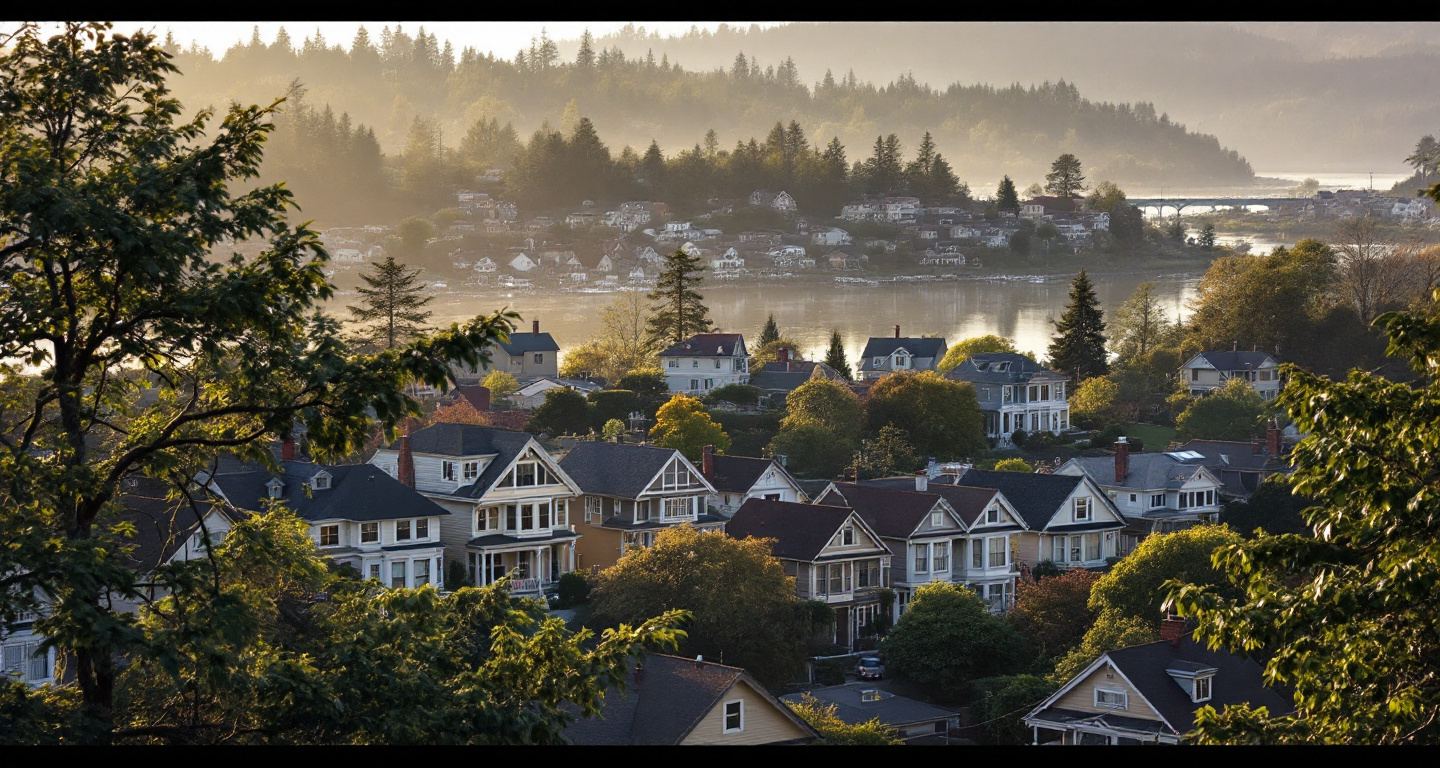
The close-in southeast neighborhoods — Sellwood-Moreland, Woodstock, Richmond, Foster-Powell — are dense with early twentieth-century construction. These homes were built for warmth, not cooling. Their original heating systems were either cast iron radiators fed by a boiler or forced-air furnaces added in later decades, often during post-war remodels. Attic space and wall cavities in these houses are frequently tight, irregular, and not designed to accommodate the trunk lines of a conventional ducted system. Adding central air conditioning to a home like this often means either a costly and invasive duct retrofit or accepting a patchwork of window units that compromise the character of the house.
The south metro corridor tends to carry more mid-century housing as you move south and west. Ranches from the mid-twentieth century were built with forced-air heating as standard, which means they already have ductwork. For these homes, adding central air conditioning is often more straightforward, requiring only a cooling coil and an outdoor condenser unit. Newer infill and condos increasingly arrive with heat pumps already installed, with year-round mechanical comfort baked into the design from the start. A general overview of home HVAC systems is at https://en.wikipedia.org/wiki/HVAC.
For the large portion of Portland's housing stock that either lacks ducts or has ducts unsuited to cooling, ductless mini-split heat pumps have become the practical answer. A mini-split separates the outdoor compressor from one or more indoor air-handling units, connected by refrigerant lines that can be routed through walls with minimal disruption. In a craftsman bungalow where adding ductwork would mean tearing open plaster ceilings, this approach preserves the home's interior while delivering both heating and cooling.
Heat pumps have grown significantly more common across the Portland metro as awareness of their efficiency has spread. They move heat rather than generate it, which makes them well-suited to Portland's mild winters. Even in cold snaps, modern cold-climate heat pumps maintain useful output, though very old homes with drafty envelopes may still benefit from supplemental heat sources. For a local example of HVAC service in Portland, see https://sites.google.com/view/efficiency-heating-cooling/service-areas/portland.
For most of Portland's history, air conditioning was considered optional. The city's proximity to the Pacific, the moderating influence of the Columbia River Gorge, and the general pattern of mild summers meant a box fan and shaded windows would carry most households through the season.
That calculus has shifted. Heat events of unusual intensity have become a recognized feature of Pacific Northwest summers, and the experience of extreme heat in a home without any mechanical cooling changes the conversation quickly. The risk is not uniform — homes with significant tree canopy, good attic insulation, and favorable orientation manage heat better than those without — but the trend has pushed cooling systems from a nice-to-have into something a growing share of Portland homeowners treat as a health and safety consideration.
Portland's winters remain wet and relatively mild by national standards. Most homes heat effectively through the rainy season without extreme strain, though the extended damp and gray creates its own pressures on envelope performance and indoor air quality. Bordering Milwaukie is covered at https://sites.google.com/view/efficiency-heating-cooling/service-areas/milwaukie.
Many of the older homes in Portland's established neighborhoods carry significant architectural character that their owners care about maintaining. Adding mechanical systems to these houses requires some thought. Mini-split line sets routed along exterior walls are functional but visually prominent; placement decisions matter. Boiler-fed radiator systems — still present in some of the oldest close-in homes — provide a particular quality of even, radiant heat that many owners are reluctant to abandon even when the systems age and require significant upkeep.
Portland homeowners dealing with original knob-and-tube wiring alongside older mechanical systems face an added layer of complexity, since electrical upgrades may be part of any meaningful HVAC improvement. The practical starting point across most of Portland's older fabric: understand what your home was built with, what has been added or modified over the decades, and how those layers interact before committing to any significant change.