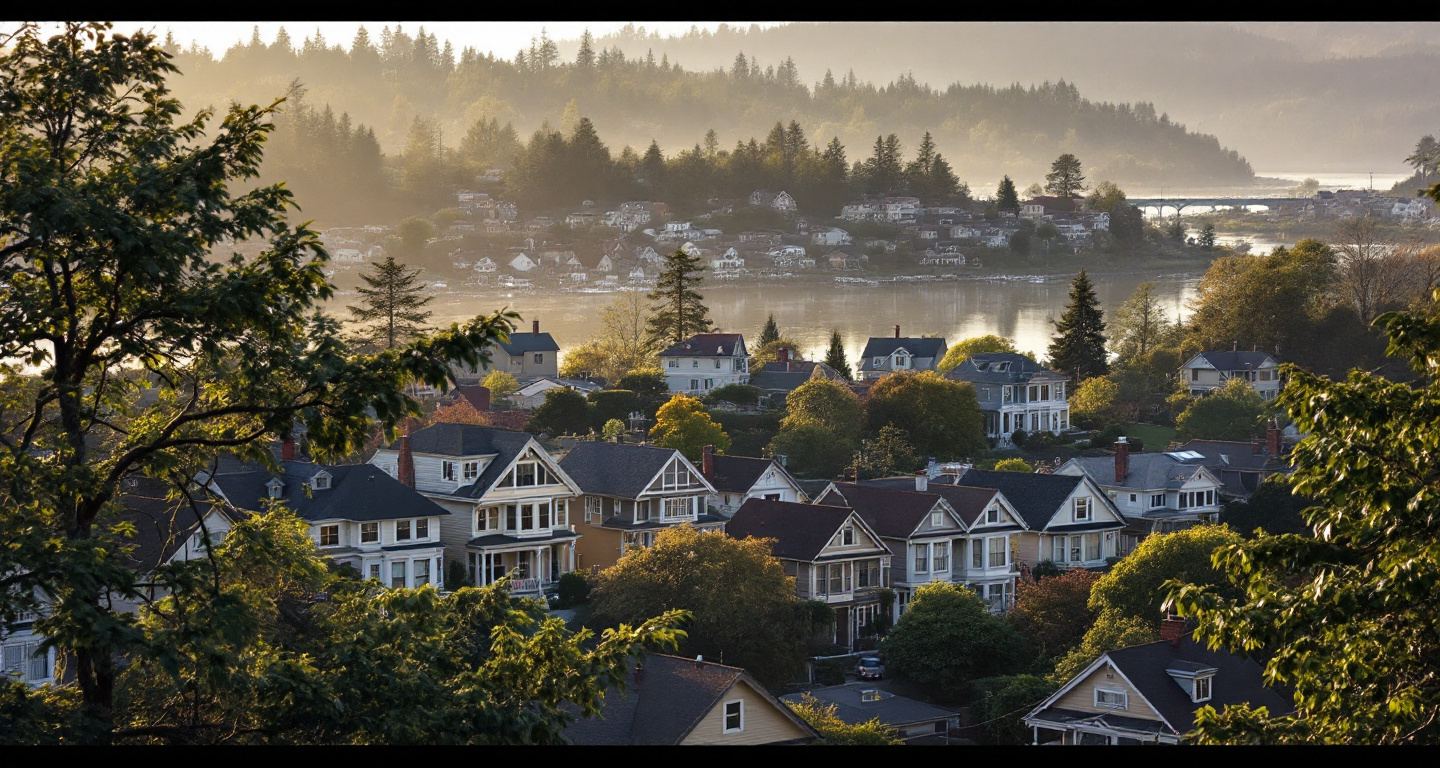
The hills and bluffs of West Linn are not uniform. Homes at higher elevations around Rosemont Ridge or on the slopes above the river face different sun exposure and wind patterns than homes tucked into wooded canyons or sitting near the flat ground along the Tualatin. A hillside home with southeast exposure and limited tree canopy heats up more aggressively on summer afternoons than a neighboring house in a hollow shaded by Douglas firs and big-leaf maples. The same solar geometry that keeps a wooded lot cool in July also means that home may take longer to warm in late fall, and a heat pump serving it may run longer cycles on cold clear days than a system serving a home in full sun.
The Willamette Valley's temperature inversion pattern matters here. West Linn, sitting above some of the valley floor fog that settles into lower areas in winter, can see meaningful temperature swings between day and night, and between wooded and open exposures. In shoulder seasons, a thermostat set for one part of a large home may work against conditions that are genuinely different in another wing or on another level. More on furnaces and boilers is in the Department of Energy furnace guide.
A substantial portion of West Linn's housing stock consists of large custom homes, many of them three stories or more to take advantage of river or hillside views. These floor plans create natural thermal stratification. Heat rises, which in a tall home means upper floors accumulate warmth while lower levels, particularly walkout basements or daylight floors built into the hillside, stay cool longer in summer and lose heat more quickly in winter. This is physics, and it is most noticeable in taller homes with open stairwells or high cathedral ceilings in main living areas.
Managing this effectively usually requires more than a single-zone forced-air system controlled from one central thermostat. Zoned systems, whether through dampers in the ductwork, separate air handlers serving different floor groups, or ductless units in rooms that need independent control, allow each level to respond to its own conditions rather than being averaged with the rest of the house. For the spatially complex homes common in West Linn, zoning is less a luxury than a practical response to the floor plan. For a local example of HVAC service in West Linn, see https://sites.google.com/view/efficiency-heating-cooling/service-areas/west-linn.
West Linn winters are wet, mild by cold-climate standards, but persistent and damp. The Pacific marine influence that keeps temperatures from dropping to extremes also means extended stretches of gray weather with relative humidity that stays high. Homes with crawlspaces or partially exposed lower floors built into hillsides may see more moisture intrusion than homes on flat ground, which can affect how efficiently a heating system performs and how comfortable lower levels feel.
Heat pumps perform well through most of a West Linn winter, since temperatures rarely drop far enough to require extended auxiliary heat. For homes heating large volumes across multiple levels, oversizing is a common temptation but usually a mistake. A well-sized system that runs longer cycles distributes heat more evenly and keeps humidity better balanced than an oversized system that short-cycles and leaves parts of the house feeling inconsistently conditioned. Just across the Willamette, neighboring Lake Oswego is covered at https://sites.google.com/view/efficiency-heating-cooling/service-areas/lake-oswego.
West Linn does not have the same summer cooling demands as parts of the Portland metro that sit on flat ground in full sun. The mature tree canopy provides real passive cooling benefit, and homes on north-facing slopes or in wooded hollows may rarely need mechanical cooling during a normal summer. But the south metro has seen increasing stretches of heat that push even well-shaded homes past what passive ventilation can manage. Homes with large glass areas on south or west elevations can build up interior temperatures during extended warm spells that take multiple nights to fully release.
For homes that do need cooling capacity, the same zoning principles that apply to heating apply in summer. Upper levels and rooms with significant glass exposure often need the most cooling attention, while lower levels built into the hillside may stay naturally cool and need little mechanical assistance.